
Workplace exposure monitoring measures employees’ exposure to hazardous substances during their work. For airborne contaminants, workplace air sampling helps establish what people are breathing and whether exposure controls are effective.
An occupational hygiene assessment considers the substances involved, the tasks performed and how exposure occurs. Examples include welding fume, wood dust, respirable crystalline silica, solvent vapours and pharmaceutical ingredients.
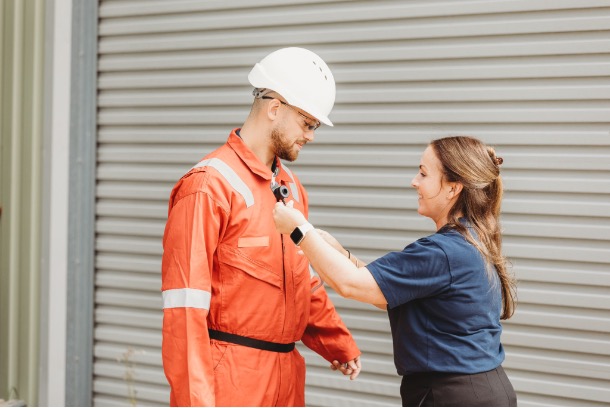
HSE’s G409: Exposure measurement—Air sampling explains how air sampling helps assess people’s exposure to hazardous substances and understand how and why that exposure occurs.
Personal air sampling uses sampling equipment worn by an employee, with the sampling head positioned close to their nose and mouth in the breathing zone.
Air is drawn through a suitable filter or other collection medium during selected tasks or working periods. Laboratory analysis determines the amount of substance collected, allowing its airborne concentration to be calculated.
Static air sampling and direct-reading instruments can provide additional information about emission sources and control performance. However, measurements taken elsewhere in the workplace do not automatically represent an individual’s exposure.
Results are assessed against relevant Workplace Exposure Limits (WELs) listed in EH40, or other appropriate substance-specific Occupational Exposure Limits (OELs), using the correct reference periods.
Not every hazardous substance has a UK WEL. Pharmaceutical ingredients, for example, may have their own substance-specific OELs.
A result below an exposure limit is not the whole assessment. Findings must reflect the tasks sampled, exposure variability and control measures. For carcinogens, mutagens and asthmagens, exposure must also be reduced as low as reasonably practicable (ALARP).
Monitoring may be needed where exposure is uncertain, to assess compliance with exposure limits, or to establish whether control measures provide adequate protection. Process changes or concerns about existing controls may also prompt an assessment.
LEV testing and exposure monitoring provide complementary evidence: LEV testing assesses the extraction system’s performance, while personal air sampling assesses airborne exposure in the worker’s breathing zone.
Armstrong Environmental provides workplace exposure assessments, personal air sampling and occupational hygiene monitoring, with practical recommendations to support effective exposure control and COSHH compliance.
Find out more about our workplace air sampling services or contact our team to discuss your processes and substances.