Workplace Noise Exposure Assessments

Armstrong Environmental provides professional workplace noise exposure assessments to help employers comply with the Control of Noise at Work Regulations 2005, protect employee health and reduce workplace risk.
Our assessments are undertaken in accordance with current UK legislation and recognised guidance, including:

Why Workplace Noise Assessments Matter

Excessive workplace noise can cause permanent hearing damage and other health and safety risks if not properly controlled.

Noise-related hearing damage is permanent but entirely preventable with suitable assessment and control measures.

Long-term exposure to high noise levels may result in:

Workplace noise assessments help employers:

What Does the Law Require?

The Control of Noise at Work Regulations 2005 require employers to eliminate or reduce risks from workplace noise so far as is reasonably practicable.

Employers must:

  • Assess risks from workplace noise exposure
  • Eliminate or reduce noise exposure at source where possible
  • Provide suitable hearing protection where residual risks remain
  • Establish hearing protection zones where applicable
  • Provide information, instruction and training
  • Provide appropriate health surveillance where employees remain at risk

The Regulations define legal exposure action values and exposure limit values.

Lower Exposure Action Values

  • Daily or weekly exposure: 80 dB(A)
  • Peak sound pressure: 135 dB(C)

Upper Exposure Action Values

  • Daily or weekly exposure: 85 dB(A)
  • Peak sound pressure: 137 dB(C)

Exposure Limit Values

  • Daily or weekly exposure: 87 dB(A)
  • Peak sound pressure: 140 dB(C)

Exposure limit values take account of the protection provided by hearing protection.

Where employees are regularly exposed above the upper exposure action values, employers are normally required to implement a programme of health surveillance, including audiometric testing.

How Do I Know If Noise May Be a Problem?

You may need a workplace noise assessment if:

  • Employees need to shout to communicate with someone approximately 2 metres away.
  • Staff use noisy machinery, power tools or plant equipment
  • Work activities involve impacts, hammering or compressed air tools
  • Hearing protection is already being used
  • Employees work in known noisy industries such as:
    • Manufacturing
    • Construction
    • Engineering
    • Woodworking
    • Metal fabrication
    • Food production
    • Recycling
    • Marine or shipbuilding

Our Noise Assessment Services

Personal Noise Exposure Monitoring

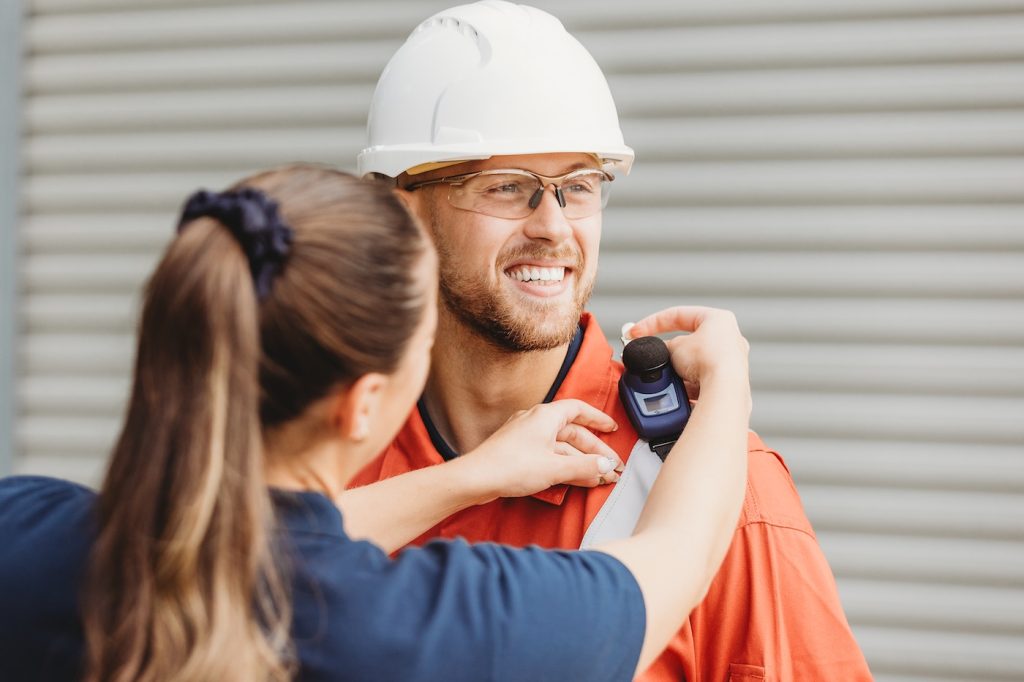
Personal noise monitoring using calibrated noise dosimeters to assess actual employee exposure throughout the working day.

Task-Based Noise Assessments

Assessment of specific tasks, machinery or processes to identify significant noise sources and determine appropriate control measures.

Area & Background Noise Surveys

Workplace sound level measurements used to assess ambient noise conditions, noise distribution within the workplace and the effectiveness of existing controls.

Hearing Protection Assessments

Review of hearing protection suitability, selection and compatibility with workplace exposure levels.

Our Assessment Process

Our workplace noise assessments follow a structured occupational hygiene methodology.

Stage 1

Planning & Risk Review

Review of work activities, exposure groups, operating conditions and monitoring objectives.

Stage 2

Workplace Assessment

Visual assessment of processes, equipment, existing controls, work practices and employee interaction.

Stage 3

Noise Measurements

Noise exposure monitoring using calibrated sound level meters and personal noise dosimeters in accordance with recognised methodologies.

Stage 4

Reporting & Recommendations

Clear technical reporting including:

  • Noise exposure results
  • Comparison against legal action values
  • Identification of high-risk activities
  • Practical recommendations for exposure reduction
  • Guidance on hearing protection and health surveillance requirements

Competent Occupational Hygiene Specialists

Our assessments are undertaken by competent occupational hygiene professionals with appropriate training, technical knowledge and practical experience in workplace noise assessment.
Staff undertaking this work meet the competency requirements outlined within:
Our team includes members of professional organisations including:

Why Choose Armstrong Environmental?

Typical Applications

Speak to Armstrong Environmental about workplace noise exposure assessments, personal noise monitoring and practical noise control solutions.

Need Workplace Noise Assessment Support?

Speak to Armstrong Environmental about workplace noise exposure assessments, personal noise monitoring and practical noise control solutions.