
A Biological Safety Cabinet (BSC) is a ventilated containment enclosure designed to protect operators, the working environment and, in many cases, the product being handled from hazardous biological agents and infectious aerosols.
BSCs use controlled airflow and HEPA filtration to contain airborne particles generated during laboratory procedures involving biological materials. Under COSHH Regulations, work involving infectious aerosols at Containment Levels 2 and 3 must be undertaken within a suitable Biological Safety Cabinet or containment device.
Biological Safety Cabinets are commonly used within:
Designed primarily to protect the operator and environment through inward airflow and HEPA-filtered exhaust air. Suitable for work involving biological agents up to HG3.
The most common BSC type, providing protection for both the operator and the product through controlled inflow and HEPA-filtered downflow air patterns. Suitable for a wide range of laboratory and pharmaceutical applications.
Fully enclosed cabinets providing maximum containment protection for high-risk biological work through negative pressure operation and glove port access systems. Typically used for HG4 applications.
Biological Safety Cabinet validation is a detailed technical examination and performance assessment undertaken to verify that the cabinet continues to operate safely and effectively in accordance with its design specification and applicable standards.
Routine validation helps identify:
Please note that under COSHH Regulation 9, Biological Safety Cabinets are considered a form of LEV and require thorough examination and testing at intervals not exceeding 14 months.
Validation and certification of newly installed Biological Safety Cabinets to establish benchmark performance standards and verify compliance with BS EN 12469 testing requirements.
Periodic examination and testing to confirm continued containment performance, airflow integrity and safe operation.
Establishing benchmark performance criteria where original commissioning data is unavailable or incomplete.
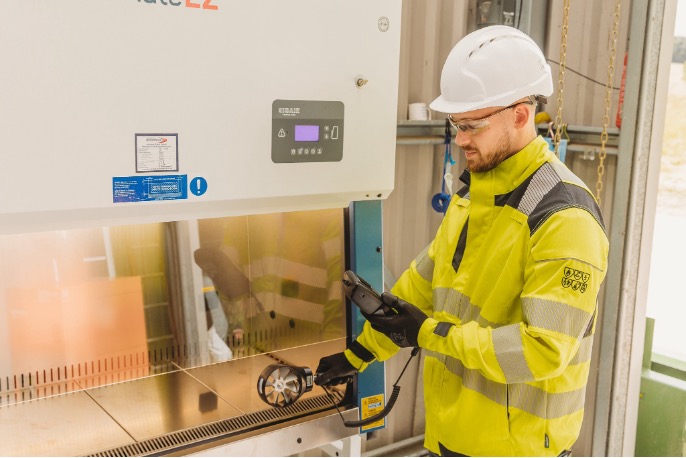


Review of existing BSC documentation, user manuals, maintenance records, COSHH assessments and previous certification reports.
Inspection of cabinet condition, installation suitability, airflow influences, filters, alarms, ductwork and operator interaction.
Performance validation using calibrated equipment and recognised test methodologies, including:
Comprehensive technical reporting including test results, professional interpretation, recommendations and certification status.