
Many Local Exhaust Ventilation (LEV) systems are thoroughly examined and tested every year as part of routine TExT. But what happens when there is no commissioning report?
It is more common than you might think, particularly with older LEV systems.
The problem is that commissioning and routine LEV testing serve two very different purposes.
Commissioning establishes that an LEV system has been installed correctly and is capable of achieving the level of control required for the process. It also establishes the performance benchmarks against which future examinations can be assessed.
Routine TExT, on the other hand, assesses whether the system continues to perform effectively against those established benchmarks.
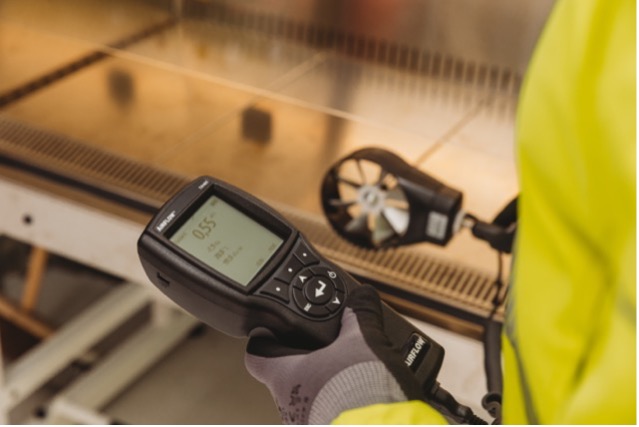
So, what if the commissioning report is missing?
Without reliable commissioning information, the numbers recorded during routine testing may have limited meaning.
For example, an LEV system may have consistently achieved an airflow of 3,000 m³/hr for the last ten years. But if nobody established that 3,000 m³/hr was actually sufficient to control the contaminant when the system was installed, what does that figure really tell you?
It demonstrates consistency — not necessarily adequacy.
Retrospective commissioning
Where reliable commissioning information cannot be located, retrospective commissioning may be required to establish whether the existing LEV system is capable of providing adequate control.
This should consider:
Workplace exposure assessment, including air sampling where appropriate, can provide additional evidence about operator exposure and the effectiveness of the controls in place.
It is also important to recognise that LEV does not necessarily operate in isolation or provide 100% control of a contaminant. The objective is to demonstrate that exposure is adequately controlled, taking account of the complete control strategy, which may include measures such as working methods, containment and respiratory protective equipment (RPE).
Once adequate control has been demonstrated, meaningful performance benchmarks can be documented and used as the reference point for future TExT examinations.
Don’t confuse a TExT result with proof of control
An LEV system may have produced a satisfactory TExT result year after year and yet still fail to provide adequate control of exposure.
If the system was never properly commissioned, there may be no evidence that its original performance was adequate in the first place.
The fact that airflow or pressure readings remain consistent with previous TExT results does not, by itself, demonstrate that the system is providing adequate control.
A system should not be considered satisfactory simply because it continues to achieve the same numbers. If those numbers were never established as representing adequate control, there is no meaningful benchmark against which to assess its ongoing performance.
Where adequate control cannot otherwise be demonstrated, retrospective commissioning provides a structured way of establishing whether the LEV system is actually capable of controlling the risk — and creates meaningful benchmarks against which its future performance can be assessed.
This isn’t just a paperwork issue
The importance of commissioning information is also reflected in HSE enforcement activity.
HSE enforcement records include cases where the absence of commissioning information has been identified during compliance activity involving LEV systems.
This reinforces the point: commissioning is not simply about having a report on file. It provides the evidence that the LEV is capable of providing adequate control and establishes the benchmark for future testing.