
Entonox, commonly known as gas and air, is widely used for pain relief during childbirth and other medical procedures. However, its use can also result in occupational exposure to nitrous oxide among healthcare professionals.
Recent reports concerning excessive nitrous oxide exposure among NHS maternity staff have highlighted the importance of understanding the risks and ensuring that appropriate control measures are in place.
For NHS trusts and other healthcare providers, workplace exposure monitoring provides valuable evidence of whether staff are being adequately protected.
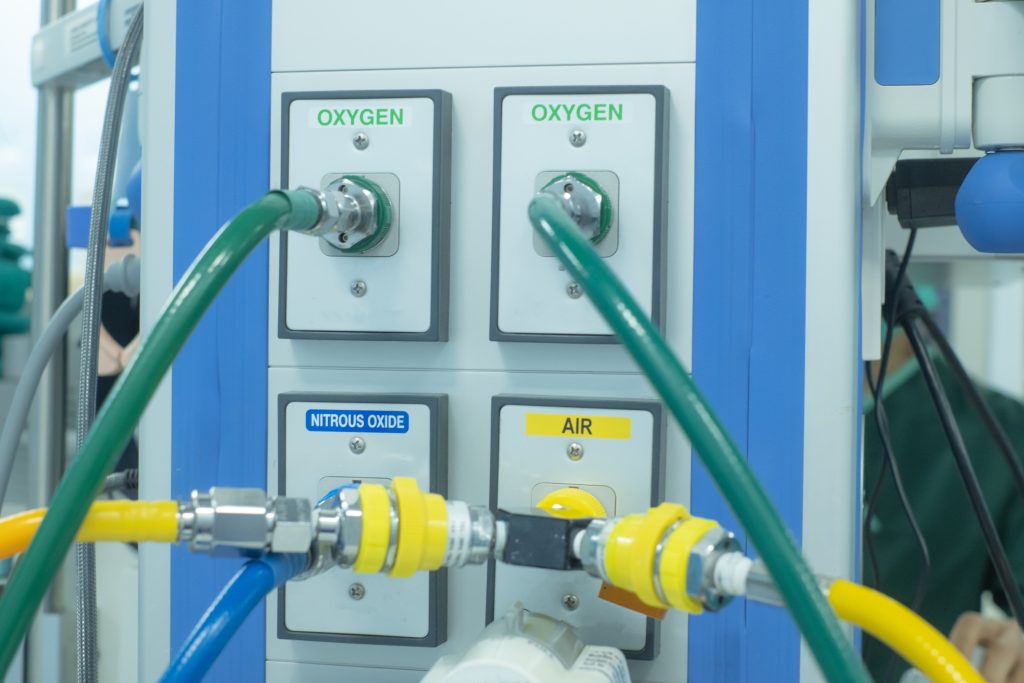
Entonox is a medical gas containing 50% nitrous oxide and 50% oxygen.
During administration, nitrous oxide can be released into the surrounding environment, particularly when patients exhale outside a scavenging mouthpiece or mask.
Healthcare professionals who may be exposed include midwives, nurses, doctors and other staff working in environments where Entonox is administered.
Excessive occupational exposure to nitrous oxide can result in adverse health effects. Prolonged exposure may interfere with vitamin B12 function and has been associated with neurological problems and anaemia.
These risks make effective exposure control particularly important in maternity units and other clinical environments where nitrous oxide is regularly used.
Under the Health and Safety Executive’s EH40/2005 Workplace Exposure Limits, nitrous oxide has a UK workplace exposure limit (WEL) of:
100 parts per million (ppm), equivalent to 183 mg/m³, measured as an 8-hour time-weighted average (TWA).
The Control of Substances Hazardous to Health Regulations 2002 (COSHH) require employers to prevent exposure to hazardous substances or, where prevention is not reasonably practicable, ensure exposure is adequately controlled.
Importantly, demonstrating compliance with a workplace exposure limit is not the only consideration. Employers must also ensure that appropriate control measures are implemented, maintained and effective.
Occupational exposure to nitrous oxide can vary considerably throughout a healthcare worker’s shift.
In maternity departments, exposure may be influenced by several factors:
Frequency and duration of Entonox administration.
Effectiveness of gas scavenging arrangements.
Room ventilation and airflow patterns.
Position of healthcare workers relative to the patient.
Correct use of mouthpieces and masks.
Working practices and patient activity.
Length of shifts and time spent in different clinical environments.
Consequently, measuring background nitrous oxide concentrations alone may not provide a representative assessment of an individual’s occupational exposure.
Personal exposure monitoring can provide valuable evidence of the concentrations healthcare workers are actually exposed to during their duties.
An occupational exposure assessment should be designed around the activities undertaken, the workers potentially exposed and the existing control arrangements.
Personal exposure sampling can be undertaken during representative working conditions to measure nitrous oxide concentrations associated with an individual’s duties.
The monitoring results can then be used to assess exposure against the relevant 8-hour time-weighted workplace exposure limit, using appropriate calculations and information about the worker’s exposure throughout the shift.
Where appropriate, additional measurements may help identify activities or locations associated with elevated concentrations.
A suitable assessment should also consider contextual information, including the duration of exposure, use of scavenging systems, ventilation arrangements and variations in clinical activity.
This information is important when interpreting results and determining whether existing control measures are providing adequate protection.
Ventilation and gas scavenging systems play an important role in controlling occupational exposure to nitrous oxide.
However, the presence of ventilation or scavenging equipment does not automatically demonstrate that exposure is adequately controlled.
The effectiveness of these arrangements can be influenced by equipment performance, room airflow, patient behaviour and working practices.
HSE guidance identifies the importance of capturing exhaled gas at source, with general room ventilation providing additional control.
Workplace exposure monitoring can help establish whether the combined control arrangements are effective under representative operating conditions.
Where elevated exposure is identified, the findings can support further investigation and improvements to existing controls.
The Health and Safety Executive has published specific guidance on using nitrous oxide safely in maternity units, covering exposure levels, control measures, monitoring and management arrangements.
NHS England has also published guidance on minimising time-weighted exposure to nitrous oxide in healthcare settings.
This guidance recommends that the effectiveness of equipment, environmental conditions, clinical practices and other control measures is assessed at least annually, supported by occupational exposure sampling.
These assessments provide important evidence for COSHH risk assessments and healthcare organisations’ wider health and safety management arrangements.
Armstrong Environmental provides specialist occupational hygiene and workplace exposure monitoring services to healthcare organisations.
Our team has practical experience undertaking nitrous oxide exposure sampling within hospital environments.
We can support NHS trusts and other healthcare providers with:
Developing appropriate occupational exposure monitoring strategies.
Personal exposure sampling for nitrous oxide.
Assessing results against the relevant workplace exposure limit.
Reviewing exposure patterns and existing control arrangements.
Providing technical reports and recommendations to support COSHH assessments.
Our approach focuses on understanding actual occupational exposure and providing meaningful evidence to help duty holders assess the effectiveness of their existing control measures.
If your organisation uses Entonox or other nitrous oxide-containing medical gases, it is important to understand whether staff exposure is being adequately controlled.
Whether you require an initial occupational exposure assessment, periodic monitoring or further investigation of potential exposure concerns, Armstrong Environmental can provide specialist support.
Contact Armstrong Environmental to discuss Entonox and nitrous oxide workplace exposure monitoring at your healthcare facilit
NHS England – Guidance on minimising time-weighted exposure to nitrous oxide in healthcare settings
HSE EH40/2005 – Workplace Exposure Limits.
HSE HSG173 – Monitoring Strategies for Toxic Substances.