
Home > Regional Coverage > East of England
Armstrong Environmental provides independent Local Exhaust Ventilation testing throughout the East of England.
We support organisations across Cambridgeshire, Norfolk, Suffolk, Essex, Hertfordshire, Bedfordshire and surrounding areas, including scientific research facilities, laboratories, regulated manufacturing sites, engineering operations and major energy projects.
Our work ranges from individual extraction systems, fume cupboards and biological safety cabinets to coordinated programmes across complex sites containing substantial numbers of engineering controls.
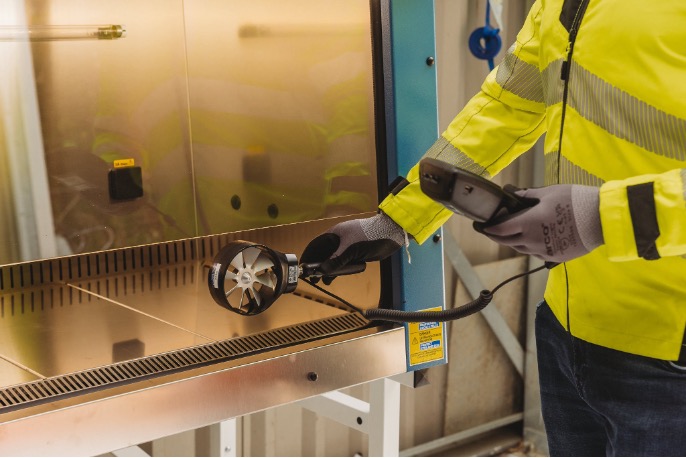
Local Exhaust Ventilation in the East of England can range from laboratory fume cupboards and biological safety cabinets to production enclosures, welding extraction, dust controls and temporary systems used on major projects.
The purpose of testing is not simply to record an airflow figure. The control must capture or contain hazardous substances during the real process, with the equipment, materials and working methods that employees actually use.
Regulation 9 of the Control of Substances Hazardous to Health Regulations requires employers to maintain control measures in an efficient state, in efficient working order, in good repair and in a clean condition.
The COSHH Approved Code of Practice and guidance, known as COSHH L5, supports these duties. HSE guidance HSG258 sets out good practice for commissioning, examining, testing and managing Local Exhaust Ventilation systems.
Most LEV systems require thorough examination and testing at least once every 14 months. Shorter statutory intervals apply to certain processes, while risk, system condition or operating changes may justify more frequent examination.
A competent LEV TExT considers the process and the complete system, including its hood or enclosure, ductwork, air cleaner, fan and discharge, rather than treating individual measurements in isolation.
Testing may include visual examination, smoke visualisation, airflow and pressure measurements, assessment of capture or containment, and comparison with commissioning information or another defensible performance benchmark.
The report should reach a clear conclusion, explain the significance of defects and provide prioritised actions. Where original commissioning evidence is absent or no longer representative, retrospective commissioning may be required to establish a meaningful benchmark.
The East of England combines the Cambridge science and technology cluster with pharmaceutical and biotechnology activity, universities, specialist healthcare, advanced manufacturing, food production and nationally significant energy infrastructure.
These environments can involve biological aerosols, laboratory chemicals, pharmaceutical powders, solvent vapour, welding fume, metalworking mist and dusts requiring reliable engineering control under COSHH.
Armstrong Environmental has experience supporting organisations across:
We understand the need to coordinate testing around experiments, production, containment, permits, security, contractor interfaces and site access while maintaining a consistent and defensible technical standard.
Research facilities, technology businesses and major energy projects change as equipment is installed, processes develop, temporary controls are introduced and work areas are reconfigured.
An airflow reading alone does not demonstrate that a control remains suitable for a changed process. Duty holders need verified assets, relevant design intent and coordinated examination and testing.
Armstrong Environmental can support commissioning, retrospective commissioning, asset verification, planned schedules, consistent reporting and prioritisation of significant or recurring defects.
LEV Tracker® provides oversight of systems, reports, examination dates and outstanding actions across laboratories, departments, buildings or multiple sites.
Biological safety cabinets are specialist LEV systems providing personnel, product and environmental protection. Their performance should be validated against BS EN 12469 and considered within the wider COSHH assessment.
Depending on the cabinet and scope, validation may include inflow and downflow measurements, smoke visualisation, operator protection testing and assessment of filter integrity.
LEV and BSC measurements do not always establish what an employee may inhale. Armstrong Environmental can design workplace exposure assessments using personal monitoring, static sampling and task observation.
Results can be considered against Workplace Exposure Limits in EH40 or suitable substance-specific criteria, including occupational exposure limits used for active pharmaceutical ingredients. Meeting a limit does not replace the wider COSHH duty to prevent or adequately control exposure.
Combining exposure evidence with LEV and containment expertise helps identify whether improvement is required in enclosure, airflow, work practices, maintenance, housekeeping or other control measures.

Clients choose Armstrong Environmental because we provide:
Our LEV testing is led by BOHS-registered LEV Specialists listed on the BOHS Register of Occupational Hygiene Professionals, which is accredited by the Professional Standards Authority.